
The highest retail lift in spending of Stampede isn’t during Stampede at all. It’s the Thursday before.
Stampede brings in roughly $400 million into the Calgary Stampede, and when the Mastercard Economics Institute dug into last year’s spending data, they found some interesting insights: an 18% overall boost at local merchants during Stampede, a 29% jump at restaurants and a massive retail spike the day before anything officially starts, driven by thousands of people realizing at the last minute that they don’t own a cowboy hat.
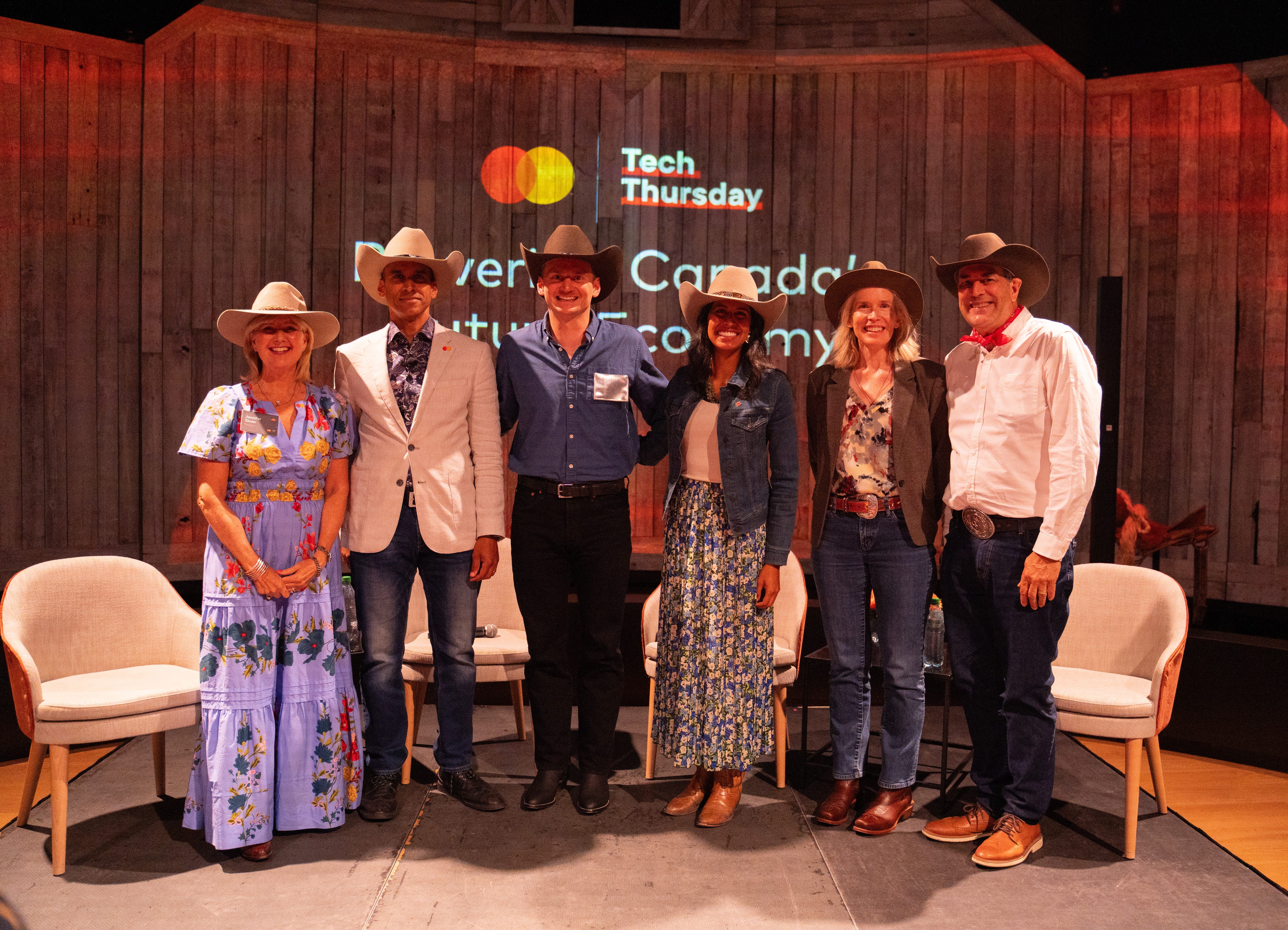
We heard this on the first Friday of Stampede, hours after the parade, inside an immersive barn at the brand new Sam Centre. The occasion was a Tech Thursday session co-hosted with Mastercard on the digital economy, and the lineup was incredible:
Claude Guay, Member of Parliament, Parliamentary Secretary for Energy and Natural Resources, and former CEO of IBM Canada
Anne Butler, Managing Director of Payments and Regulatory Oversight at the Bank of Canada
Ruhee Ismail-Teja, VP of Policy and External Affairs at the Calgary Chamber
Benjamin Jacob, SVP of Services at Mastercard
Jennifer Sloan, SVP of Government Affairs and Stakeholder Engagement at Mastercard
And, myself, Philippe Burns, Co-Founder of Tech Thursday

This is our recap of the top ideas from the conversation.
“We are not Team Pitchfork that believes the world is gonna go to hell with AI and robots are gonna take over. But we’re not Team Pompom either.” Claude Guay

Missed this one? Check out our recap videos on YouTube, Spotify, or Apple Podcasts and follow us on Instagram for updates on everything Tech Thursday.
1. Stampede Is an Economic Driver for Canada
The takeaway: Stampede isn’t just a cultural moment, it’s one of the cleanest windows into how Canadians actually spend, and the patterns in the data are more actionable than most businesses realize.
Benjamin walked through the Mastercard Economics Institute’s analysis of the 2025 Stampede. The headline numbers: an 18% total spending boost at local merchants versus baseline, restaurants up 29%, and meaningful international demand: preliminary travel booking data for 2026 shows travel to Calgary growing this year from the Netherlands, Belgium, the UK, and Australia.
But the insight he kept returning to was timing. The single biggest retail spending peak happens the Thursday before Stampede, when everyone scrambles to get outfitted.
Ruhee sharpened the point from the Chamber’s side: the Stampede doesn’t publish visitor targets because demand is so sensitive to economic conditions, which makes planning brutal for businesses, especially restaurants sitting on perishable inventory. The data to de-risk those decisions exists. The gap is sharing it in real time.
Why this matters: Value from big moments isn’t evenly distributed. It’s shaped by timing, location, and behaviour and the businesses that can read those patterns get to act on them while everyone else is guessing.
2. The $1.7 Trillion Question: Who’s Responsible When Your AI Buys the Wrong Hat?
The takeaway: Agentic commerce, or AI agents that search, compare, and eventually complete purchases on your behalf, is projected to be a $1.7 trillion market by 2030, and the entire thing runs on a trust problem nobody has fully solved yet.
Benjamin laid out the shift: 71% of consumers say they want AI to streamline their shopping. The next wave isn’t AI helping you research a purchase, it’s AI executing the purchase on your behalf with strict guardrails and parameters. And that raises questions we never had to ask when humans were at the helm.
If your agent puts a dark-coloured hat in the cart when you asked for a light one, and it ships. Whose fault is that? How does a retailer know the request behind a transaction is actually authorized? How do you know your agent is buying from a legitimate site?
Mastercard’s answer is a trust layer built into the network itself, they call it Agent Pay. With authentication and agentic tokens that register intent, so merchants and banks have the data to know who (and what) they’re transacting with.
“These are things we didn’t have to worry about in the past because we were right at the helm. When you’re letting those decisions be made on your behalf, we want to make sure the data that merchants and banks are going to need is all available to them.” Benjamin Jacob
Why this matters: 2030 is not far away. Every retailer in Calgary is about to have a new kind of customer: an AI agent comparing their price, inventory, and reputation against everyone else’s. Being legible to agents is about to become a distribution channel.
3. Team Pitchfork vs. Team Pompom: Inside Canada’s AI Strategy
The takeaway: Canada’s new AI for All strategy, built from input from 11,300 Canadians, is deliberately a frame rather than a fixed plan, organized around trust, adoption, and sovereignty. And the government is refreshingly candid that Canada leads the world in AI research while lagging badly in AI usage.
Claude Guay is a rare profile in Parliament: a former startup founder and IBM Canada President now serving as a Parliamentary Secretary. His summary of the government’s posture became the line of the night, not Team Pitchfork (AI doom), not Team Pompom (AI cheerleading).
On trust, the strategy points toward regulation to protect children’s data, take down deepfakes, and defend against foreign interference, which, he noted, is already happening. On adoption, the plan is to put AI in everyone’s hands: tools for every postgraduate, AI in school curricula, education and tax credits for small businesses, and a $1 billion commitment to applying AI to healthcare. On sovereignty, Canadian-based models running on Canadian infrastructure that businesses can trust.
He was equally direct about the scale-up problem, from experience: a round he could raise $1 million for in Canada was worth $10 million in Silicon Valley, and the next round $100 million versus $10 million here.
His test for trustworthy AI was simple:
“Always be wary of AI that cannot quote the sources of where they got the information. AI should be a tool that augments Canadians and Canadian businesses, not replaces them.” Claude Guay
Why this matters: The strategy explicitly frames AI as an everyone-technology, not an enterprise-technology. For Canadian builders, the signals to watch are procurement (will government buy Canadian AI?), certified sovereign models, and the small business adoption programs, because that’s where the market gap is biggest.
4. Inside the Bank of Canada’s Playbook for Trusted Payments
The takeaway: The Bank of Canada sees payments as the literal plumbing of the economy, and Anne Butler’s team is building the modern guardrails that let innovations like real-time payments, tokenization, and agentic commerce scale with confidence.
On Anne Butler’s first day at the Bank of Canada, a team member put a giant blue plumber’s wrench on her desk: a reminder that she’s in charge of the safety of the plumbing of Canada’s financial system. It’s still there.
Her survey of what’s flowing through those pipes right now reads like a roadmap of where payments are headed: stablecoin exploration, tokenized deposits and assets, agentic commerce, and real-time payments arriving in Canada at the end of the year. Her team’s job is making sure Canadians can embrace all of it safely, and the frameworks are landing fast: retail payment providers are now supervised, draft consumer-driven banking regulations were published last week, and stablecoin regulation is on the way.
Her framing for anyone building in payments: the regulatory work isn’t a compliance exercise. Trust is the product, and it’s what lets a small business have a great revenue day during Stampede weekend without thinking about the rails underneath.
“That opportunity to help build and keep expanding that trust is really exciting, and it’s really important for us to build as an economy.” Anne Butler
She also delivered one of the best unscripted moments of the afternoon. Riffing on our AI predictions wall (more on that below), she shared that she recently used Claude to build herself a tool that scans the internet for risk signals relevant to the payments business, with no coding background at all.
Why this matters: The institutions overseeing Canada’s financial infrastructure aren’t reacting to innovation from a distance. They’re adopting the same tools, building the frameworks in step with the technology, and treating trust as the foundation that lets the whole ecosystem move faster.
5. The Adoption Gap Is the Whole Story
The takeaway: 30% of businesses are adopting AI. Among small businesses, it’s 8%. That gap, not the technology itself, is the defining economic risk and opportunity in the room.
Ruhee brought the Chamber’s data: business challenges are up across the board, but so is optimism. Companies increasingly believe they can take on what’s coming. The problem is the K-shaped divide forming between businesses embracing AI and those standing still. Her advice for the 92% of small businesses on the sidelines: don’t start with a supply chain overhaul. Pick one or two measurable, low-cost use cases, even just smarter staff scheduling, and look back at the impact.
Benjamin put the stakes plainly with a line borrowed from his IBM days: you shouldn’t be worried about AI taking your job, you should be worried about someone using AI taking your job.
Tech Thursday’s contribution to the argument was standing outside the venue. The predictions wall. We built a tool where you scan a QR code, post where you think Canada’s digital economy will be in 2030. It was built by our designer, who has no coding experience, in about 10 minutes with Claude Code. Two or three engineers and a full day of work, collapsed into a prompt.
Why this matters: When the cost of building software approaches zero, software stops being a moat. The moats that remain are distribution, relationships, and expertise which, fittingly, is also the case for Stampede itself. As Ruhee pointed out, the most striking thing about Stampede week is how little anyone is on their phones. The deals still get done in person. Preferably in cowboy boots.
A Few Takeaways for Builders
Stock the shelves before the party starts. The biggest Stampede retail day is the Thursday before it begins. Demand data beats demand instinct.
Get legible to agents. By 2030, agentic commerce is projected at $1.7 trillion. AI agents comparing your product against competitors’ is a distribution channel/ Start thinking about how they’ll find you.
Distrust AI that can’t cite its sources. Claude Guay’s test for trustworthy AI is a good default for choosing your own tools.
Start embarrassingly small. With small business AI adoption at 8%, the advantage goes to whoever just tries something measurable this quarter. Even if it’s staff scheduling.
Software is no longer the moat. A designer built our predictions wall in 10 minutes; a regulator with zero training built her own scanning tool. Your moat is distribution, relationships, and domain expertise.
A massive thank you to Benjamin, Jennifer, Claude, Anne, and Ruhee for being so generous with their time and insights, and to the Mastercard team for co-hosting an unforgettable first Friday of Stampede with us at the Sam Centre. Thanks as well to everyone who grabbed a hat, made a prediction on the wall, and joined the cowboy cosplay.