


Last week’s Tech Thursday session might have been our most candid panel yet. The conversation tackled a topic that everyone in Canadian tech talks about privately and almost no one talks about publicly: how pervasive government funding has become, and what it’s doing to how companies actually get built.
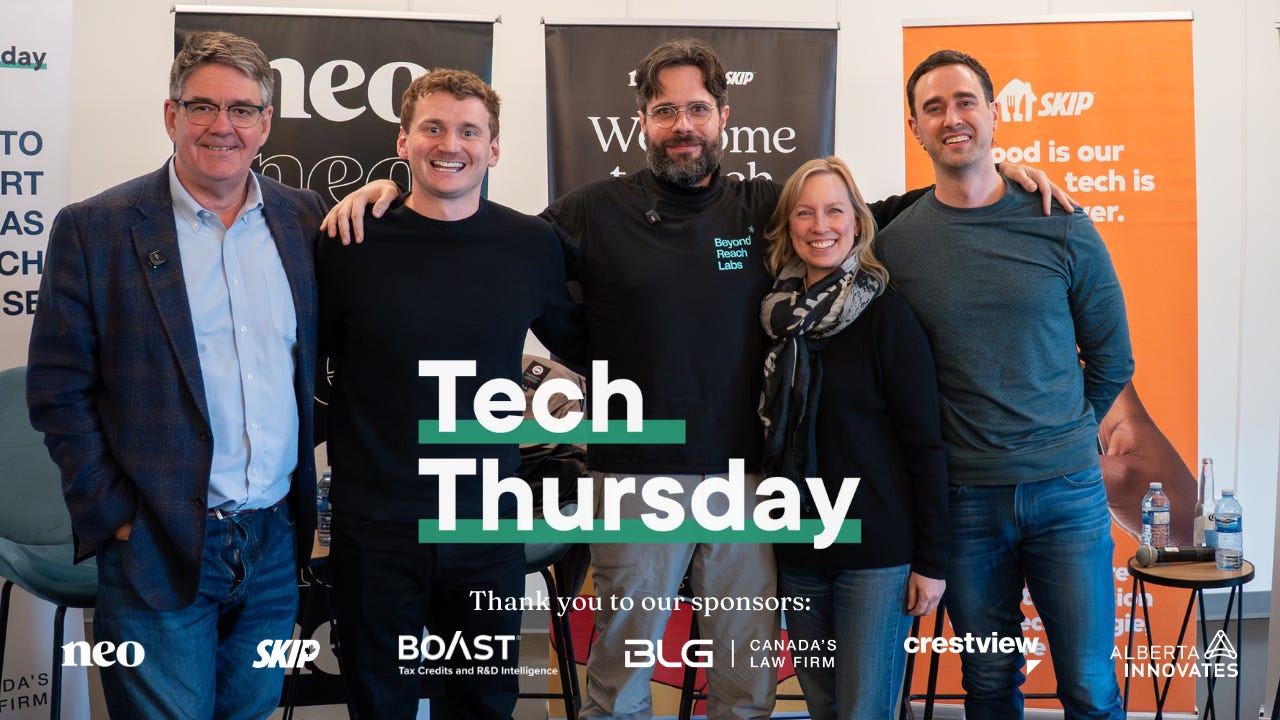
The panel featured:
Derrick Hunter, CEO of Bluesky Equities and board member of Alberta Enterprise Corporation
Graeme Harrison, Managing Partner at Augur VC
Michelle Scarborough, formerly Managing Partner of BDC Capital’s Thrive and Women in Technology Funds
Cam Linke, CEO of Amii (Alberta Machine Intelligence Institute)
This is our recap of the top ideas from the conversation.
“Management fees are like heroin. Once you get addicted to them, it’s impossible to stop.” — Graeme Harrison, citing Tony Fish

Missed this one? Check out the full panel → on YouTube, Apple Podcasts, or Spotify.
The Frame: The House Is Flooded
The conversation opened with a metaphor: government funding to a tech ecosystem is like water to a houseplant. The right amount is essential. Too much and you get root rot. Right now, the house is flooded.
That flood shows up in three places: grants, venture capital, and non-profit ecosystem support organizations. Each comes with its own version of the same problem: misaligned incentives. We worked through all three.
1. Grants: The Incentive Problem
The takeaway: Canada has built a grant ecosystem that is structurally misaligned with what actually builds successful companies, and founders pay the price in lost time.
Cam Linke captured the dynamic best when he laid out what alignment actually looks like in venture versus what it looks like in most Canadian grant programs.
“As an investor, I’d love to have no employees in a company, they’re all just painful, and have all of that go to my exit. Whereas the government wants to have all employees in the company when they’re putting money in. So you’re completely misaligned on incentives.” — Cam Linke
Cam’s broader point: Canada has stacked grant program after grant program around metrics that aren’t aligned with venture outcomes. Programs measure jobs and survival rather than revenue or customer traction. The result is an ecosystem that keeps companies alive instead of forcing them to either find product-market fit or return their talent to the community.
Graeme Harrison was direct about what he tells founders considering a grant application:
“The amount of times you can talk to a customer, that’s the only thing that’s really valuable when you’re at the pre-seed stage. The idea that you could spend eight months applying for a grant is just so off the competitive meta. There’s no point doing it. You’ll probably die as a business before you find out if you’re going to get the grant.” — Graeme Harrison
Why this matters: Pre-seed and seed-stage companies should be iterating quickly. Long grant cycles artificially extend the feedback loop between founders and customers. The exact loop that needs to be as short as possible to build something that works.
2. Venture Capital: The Returns Problem
The takeaway: Canadian VC is heavily dependent on government LP capital. That dependency has shaped GP behaviour in ways that hurt founders, and the returns of the asset class as a whole reflect it.
This was the longest section of the conversation, and it’s where the panel got sharpest.
Michelle Scarborough explained how the structure of Canadian VC creates fundamental misalignment between fund managers, their LPs, and the founders they back:
“We’re looking to invest in your company, partner with you, which means we’re married for the next 10 years, 15 years around the right timeframe these days. But I know my limited partners need to get their money back in seven or 10 years at the top. So now I have to artificially work with you to say, ‘Hey, can you speed up your exit?’” — Michelle Scarborough
She also surfaced the broader returns picture: Canadian VC funds have historically returned around 1.1 to 1.2x MOIC, meaning you put a dollar in and you get a dollar back, on a 10-to-15 year timeline. That’s not the asset class working as designed.
Graeme, whose firm Augur VC has deliberately not taken government LP capital, explained why that decision was deliberate:
“People get addicted to management fees. Tony Fish, who’s a 30-year VC, recently wrote that management fees are like heroin. Once you get addicted to them, it’s impossible to stop. You see these big fund-of-funds, especially out east, where they’ve gotten so much money out of government that they’ve become more of a grant-writing agency in disguise, as opposed to a traditional venture investor seeking to convert distributions into profits.” — Graeme Harrison
Derrick Hunter built on the point with a number that stopped the room:
“There’s vanishingly few venture managers in Canada that are ever going to reach their carry. It’s less than 10%. Once you know you’ll never hit that 8% hurdle, you’re just in the business for the rake. And if you’re just in the business for the rake, you don’t have an incentive to sell anything ever, because if you sell, your AUM goes down.” — Derrick Hunter
Derrick made the broader structural point that’s now becoming central to this debate: there’s a difference between economic development and venture capital, and Canada has been blurring the two.
“There’s absolutely a role for government in economic development. AEC’s mandate legislatively says it’s an economic development organization, and it’s checked every box. But when there’s all these restrictions [like] invest in this region, invest in this class of citizen, it’s not venture anymore. We’ve confused the two in this country, and that’s why we’re on a bad track.” — Derrick Hunter
Why this matters: Pace of play matters. Graeme noted that San Francisco VCs regularly write pre-seed cheques in 30 minutes. In Canada, the same decision can take 8 to 12 weeks. That difference in tempo isn’t a minor cultural quirk, it’s a direct consequence of the LP base, and it costs founders real time at the most critical stage of building.
Brought to you by:
Boast - Are you leaving innovation capital on the table? Boast combines AI-powered automation with specialized tax expertise to help tech companies maximize R&D credit returns. Join 2,000+ businesses who've secured $675M+ in funding. Get your free assessment at boast.ai

3. Non-Profit ESOs: The Alignment Problem
The takeaway: Canada has hundreds of accelerators and incubators, but the ones that work share a structural feature: alignment between the program, the founder, and the outcome. Most Canadian programs don’t have.
Cam framed this argument better than anyone has in public so far:
“YC puts in money, they get a part of your company, and they’re successful when you exit. Most things in Canada that we call accelerators aren’t actually set up that way. We have a whole bunch of accelerators that mimic what’s going on at YC: there’s dinners, there’s classes. But they don’t have alignment. The best programs create alignment between the entrepreneur, the program itself, and the outcome. Most of our programs aren’t set up that way.” — Cam Linke
Derrick brought a useful counterexample. He’s been a fellow at CDL Rockies since day one, and noted that CDL began as a privately financed program where investors put in their own money and time. That structure was private capital and private mentors. The early version worked.
The risk, several panelists noted, is that programs end up reporting on metrics like job creation and one-year survival rate, which are easy to claim and not strongly correlated with actual outcomes.
Michelle named the deeper structural issue:
“If all the organizations are getting their money from the same pots, and there’s no discussion at the board levels about how they’re going to incentivize good behaviour, we’re not going to get there. It’s not spread the peanut butter. It’s how do we get entrepreneurial thinking out of the brain and into action so we have the right people helping the right companies be successful.” — Michelle Scarborough
Why this matters: When ESOs report on metrics that don’t reflect actual founder outcomes, more programs get funded that produce more reports, but not necessarily more successful companies. The fix isn’t more programs. The fix is alignment.
The Closer: What Would You Change?
We closed the panel by asking each panelist what they’d do with a magic wand. The answers were unusually concrete.
Derrick Hunter: Eliminate Alberta’s provincial capital gains tax. “You only benefit if you’re a taxpayer in Alberta. There could not possibly be a bigger magnet to the world saying we’re open for business with entrepreneurs.” The cost would be about $400 million against a $80 billion provincial budget, which is, in his words, trivial compared to the signal it would send.
Graeme Harrison: Pay the top 2 to 3% of students at the best Canadian universities to drop out and start companies. “You’re not going to see the same yield off of a culture that’s highly institutional that you will from one with real grassroots entrepreneurship behind it.”
Michelle Scarborough: Stop waiting for permission. “The only way we’re going to get ahead is if we compete. We have all the tools and resources here. Let the markets decide to a greater degree, take best practices from the U.S., and stop naval gazing.”
Cam Linke: Fix Canadian procurement. “The biggest source of funding every startup should want is customers. We’re terrible at being customers of Canadian startups, as the government, and as corporate Canada. Fourteen percent of Canadian GDP is procurement. If we stopped being biased against Canadian companies, you’d fix almost all of this.”
A Few Takeaways for Founders
A few practical points that came out for founders specifically:
Look at your VC’s LPs before you take their money. Their incentives become your incentives. Government LP capital often comes with checklist requirements that can shape how a fund manages its portfolio.
Pace of play is signal. If a fund takes 12 weeks to write a pre-seed cheque, that tells you something about how they’ll behave at every subsequent decision point.
Don’t tie your thesis to a policy wind. Defense, AI, sovereign compute, critical minerals: policy windows open and close. As Graeme put it: “Find something you’re nuts about and run off into the desert by yourself.”
Customers solve more problems than capital does. This came up across all four panelists, in different ways. The companies that don’t get caught in any of the three traps tend to be the ones that figured this out early.
A massive thank you to our panelists for being so candid, and to everyone who came out for what turned into one of the most substantive conversations we’ve hosted.

Coming up at Tech Thursday:
April 30 (Tonight!) — How Energy and Mining Can Lead AI Adoption in Canada
Energy and mining don’t usually headline AI conversations. Maybe they should. The data density, operational scale, and high stakes of these industries create exactly the conditions where AI delivers real value, and the companies operating in this space are starting to move faster than most people realize. Featuring:
John Mortimer (CTO, GeologicAI)
Keri Lee (Managing Director, BlueMarvel AI)
Josh Malate (Co-Founder and President, Ultimarii)
May 21 — Building Fintech in Canada with Wealthsimple
Building in fintech at scale leaves you with a lot of lessons. We’re co-hosting this one with Wealthsimple, with their engineering and product leaders sharing the decisions behind some of Canada’s most-used financial tools: what they launched, what they learned, and what they’d do differently. Featuring:
Channing Allen (Sr. Engineer at Wealthsimple, Co-Founder at Plenty)
Jocelyn Jeffrey (Director of Engineering, Wealthsimple)
Sam Newman-Bremang (Sr. Director of Product, Wealthsimple).
🫶 News from our Friends
eStruxture is launching CAL-3, their newest data centre, on May 22nd in Calgary! This event is more than a grand opening, it’s a gathering of the community that makes the Alberta Tech Corridor one of the most exciting ecosystems in North America. It brings together 200+ decision-makers, government officials, and the innovators who are driving our local economy forward. More info and RSVP here!