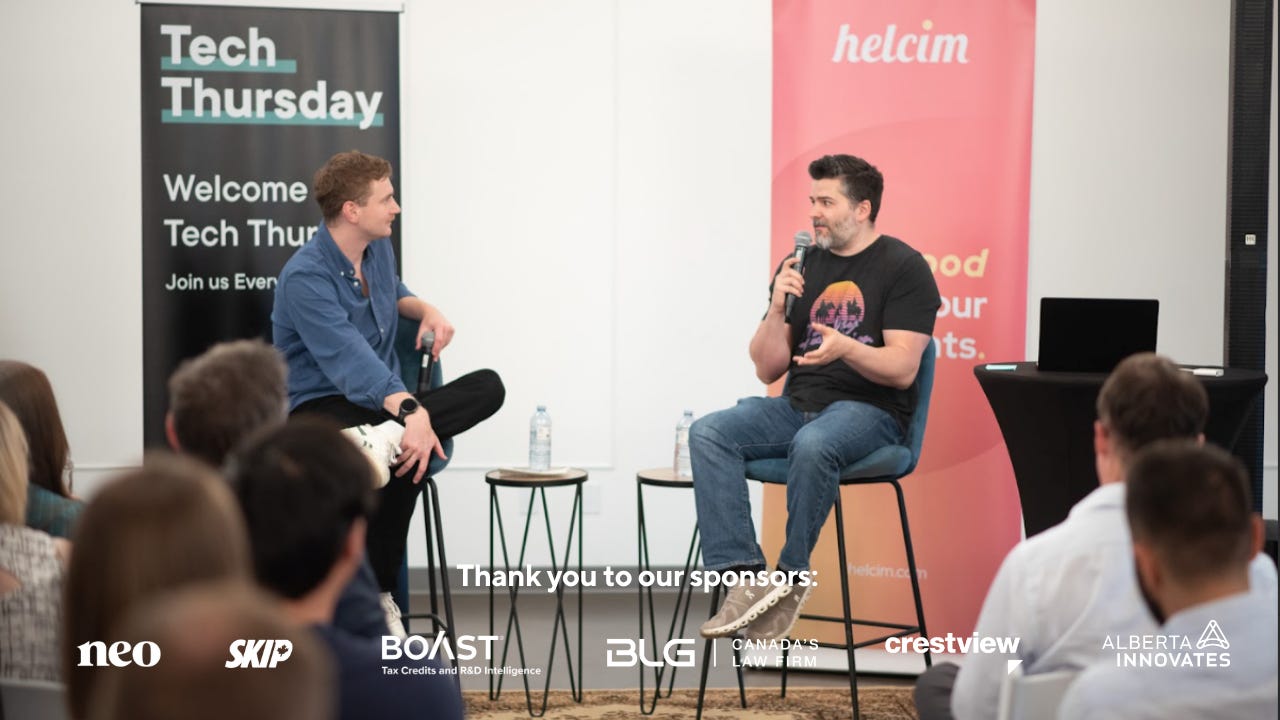

Last month, Tech Thursday co-hosted an evening with Helcim, a Calgary-based payments company that has been quietly building one of the most interesting fintech stories in Canadian tech.
The guest was Nic Beique, Helcim’s founder and CEO, who walked us through how the company went from reselling bank services to building a full payments processor from scratch, why he staffed that rebuild with junior developers, and how culture became the thing that held it all together.
"How hard could it be to build a Square or a Stripe from scratch?… It'll take 12 months... it took three years."

Missed this one? Check out our recap videos on YouTube, Spotify, or Apple Podcasts and follow us on Instagram for updates on everything Tech Thursday.
1. Nobody Builds a Payments Company in Calgary
The takeaway: Helcim wasn’t built on a playbook. It was built on the conviction that small and medium businesses deserved to be treated better and a team willing to make it happen.
Nic is a self-taught developer. He was born in Texas, grew up in Montreal, moved to Calgary at 12, and by 15 was cold-pitching local businesses on websites.
By 2008, he was 23 and deep in e-commerce development at a moment when payments infrastructure was genuinely bad. So Helcim started building payment gateways, tried to partner with Canadian banks, got turned down everywhere, and eventually found a US bank willing to let them operate as a reseller.
That model ran for about 10 years. It worked, up to a point.
“We were kind of stuck as a reseller... if we’re gonna go and treat small businesses the way that we think they truly can be treated, we’re gonna have to go and get unshackled.”
The itch was always there. Square and Stripe were growing, but small businesses were still getting gouged. The reseller structure didn’t give Helcim the control to do anything about it. In 2017, after three years of persistent negotiation with their bank partner, Nic got the green light to go independent.
2. Three Years, 15 Junior Devs, and a Blank Slate
The takeaway: Helcim rebuilt itself from scratch with a team of mostly junior developers, and the naivety wasn’t a liability. It was what made the project possible.
Starting in 2017, Helcim pulled every dollar out of the old business and hired a team, most of them recent SAIT graduates, to build a full payments processor from the ground up. The original timeline was 12 months.
It took three years.
The reason wasn’t lack of effort. It’s that payments infrastructure doesn’t allow for lean development. You can’t release the hardware without the fraud detection, the ledger, the money movement, and the KYC systems all working together. Everything has to be ready before anything can ship.
“Nobody told us we were crazy. And nobody had enough experience to tell us we were crazy. So nothing seemed insurmountable.”
Helcim 2.0 launched in spring 2020.
3. Raising Capital When You Don’t Fit the Template
The takeaway: Helcim didn’t fit the standard VC template. What ultimately landed the Series A was something investors rarely list as a criterion: intentional culture.
The push to raise capital came from Helcim’s CFO, who walked into Nic’s office in 2021 and pointed out that nobody builds a payments company without investment dollars.
The fundraising process was a grind. Helcim was bootstrapped, had been technically operating for 12 years (which confused everyone), and was going after a market most investors thought had been already won.
“You realize how much venture capital is about templates and fitting within a box.”
Later, one investor told Nic what made the difference, it wasn’t the market size or the technology, it was that Helcim was unusually intentional about its culture.
That led to the Series A. Then the grind in 2024, through a tough fundraising market for the Series B round.
4. The Culture Book Nobody Expected Them to Publish
The takeaway: Helcim published its culture code publicly in 2021. What felt risky turned out to be one of the best recruiting decisions the company ever made.
The culture at Helcim is built around four values: we are builders, we are trustworthy, choose the harder path, and we are a company of many. The full culture book lives at helcim.com/theway.
Publishing it wasn’t an obvious choice. Culture books existed, but most companies kept them internal. Helcim’s logic was simple: people are going to find out what kind of company you are eventually, so you might as well tell them up front.
The one that gets tested most, in Nic’s view, is choosing the harder path.
“It’s easy to think about how you shortcut... we could increase rates, we could charge extra for that. You have to catch yourself and be like, first of all, it’s not your values.”
Helcim also runs what it calls open book management. Financials are shared with the whole company every quarter, including balance sheet, revenue, and cash runway. The fear going in was that transparency would cause panic in hard times and entitlement in good ones. The reality was the opposite. When Helcim went into the Series B fundraise with six months of runway, the team’s response was to push harder on product and marketing, not to run for the exits.
“People talk about it, but they don’t talk about it negatively. We’ve had people say, ‘I miss that era.’”
A Few Takeaways for Builders
Conviction can outrun the playbook. Helcim’s 2.0 rebuild succeeded partly because the junior team was too optimistic to be paralyzed by the scope.
The reseller years weren’t wasted. Ten years building customer relationships and learning the payments stack was the foundation for going independent.
Culture books are recruiting tools if they’re honest. Self-selection works both ways. The people who read it and leave are doing you a favor.
Transparency in hard times is an asset, not a liability. Helcim’s open book management held the team together through its hardest fundraising stretch.
A big thank you to Nic for being so open about the whole arc, and to Helcim for co-hosting the evening with us.

🧑💻 Helcim is hiring!
Helcim is growing towards a goal of 180 people by year-end, with openings across engineering, product, data, sales, and more. See the open roles at helcim.com/careers.